


When we look for answers to personal challenges, relationship patterns, or even leadership struggles, systemic approaches give us a map. Two such approaches – the Marquesian constellation and the classic family constellation – share similar roots, yet they guide us in different directions. By understanding their distinctions, we can see how each method supports emotional growth, social impact, and the transformation of collective patterns.
Understanding the roots of classic family constellations
Classic family constellations emerged from the insight that family systems behave as interconnected emotional networks. Patterns repeat, loyalties endure, and sometimes unresolved pain from ancestors is carried forward unconsciously. In these constellations, issues are mapped through representational exercises. Typically, participants choose individuals to stand in for family members, placing them in relation to each other in a physical space. Those representatives often report sensations, emotions, or impulses echoing the roles they embody.
Through this structured representation, hidden dynamics surface. We might see longstanding exclusions, unspoken guilt, or entanglements within ancestral stories. Observing these, the facilitator may guide representatives to express withheld feelings or adopt healing sentences, attempting to bring recognition and resolution to what was concealed.
Sometimes clarity means simply seeing what has always been there.
Such constellations emphasize how personal suffering is linked to broader family histories. In our experience, people are frequently surprised at the depth of insight they gain in a single session.
Unfolding the Marquesian constellation
While Marquesian constellations share the value of systemic vision, we notice several differences in their orientation and method. Marquesian work builds on a core belief: that each individual’s consciousness, emotional maturity, and internal regulation fundamentally shape those around them, not just passive inheritance.
Rather than focusing mainly on ancestral patterns, the Marquesian constellation integrates five sciences: psychology, philosophy, meditation, systemic vision, and human valuation. This integration brings a broader understanding of how our conscious choices, emotional maturation, and self-regulation ripple outward.
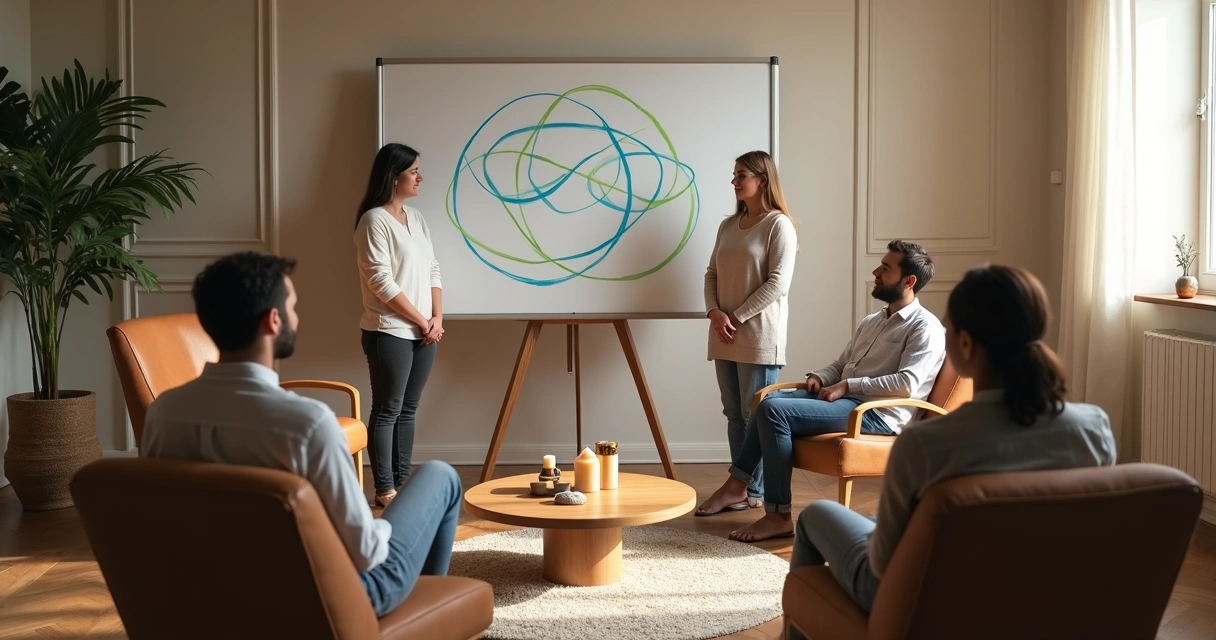
In a Marquesian constellation, more emphasis is placed on our current emotional state, the way we take responsibility for impact, and the direction of our own development. We may still use representatives, but the focus is less on resolving family traumas and more on how our state of integration changes our environment. We believe the inner maturity of the facilitator and the client is what shapes both the process and its results.
Key pillars of the Marquesian approach
- Responsibility: Encourages conscious ownership over our part in relationships and systems.
- Integration: Supports the development of inner balance rather than only searching for past causes.
- Presence: Roots the experience in present-moment awareness and emotional regulation.
- Systemic vision: Expands the focus to communities, organizations, and social fields—not just family units.
- Applied maturity: Aims for practical changes in behavior, leadership, and relational patterns beyond insight alone.
These elements help to prevent the process from becoming either a dramatic retelling of old wounds or a detached intellectual exercise.
Contrasting the experiences
To illustrate, let’s imagine two people facing similar issues: strained relationships at work that seem to mirror old family dramas. In a classic family constellation, representatives might reveal a deep loyalty to a parent’s suffering, unconscious guilt, or family secrets influencing present interactions. The session could end with symbolic gestures of release, acknowledgment, or the repositioning of representatives to reflect renewed harmony.
In the Marquesian format, while these underlying loyalties are not ignored, the main direction often shifts. The facilitator may invite the person to observe their current state—what is they are sustaining emotionally—and where, in their body or posture, old patterns become activated. The process encourages self-regulation, integration of emotion, and adoption of mature responses, guided by philosophical principles and meditation techniques. The impact of this shift is then evaluated not just in terms of relief, but in how decisions, behaviors, and relationships adjust in the “real world.”

The present is shaped by what we carry, but also by how we choose to carry it.
The implications for personal and collective transformation
In our observation, the differences between the Marquesian and classic approaches reflect a shift in how we understand change itself. Classic family constellations help illuminate the hidden emotional inheritances that shape us. But the Marquesian constellation seeks to empower us, not only to recognize what we have inherited, but to transform the direction of our impact with maturity and conscious intent.
- In classic family constellations, healing is often about reconciling with the past.
- In Marquesian constellations, healing involves integrating emotion, stabilizing presence, and acting with responsibility now.
- Classic constellations stay close to family lineage; Marquesian constellations work equally well in organizational, educational, and cultural settings.
This subtle difference shows up in practice. When we apply the Marquesian constellation in community projects or business teams, the focus becomes the emotional field present in the room—the maturity or reactivity from which decisions spring. It is less about ancestral stories, and more about the quality of awareness and balance that participants are able to generate and sustain together.
The role of the facilitator and participant
In both approaches, the skill and presence of the facilitator are meaningful. However, Marquesian facilitators are invited to act from their own state of integration, embodying the maturity they seek to foster. Participants do not passively observe the play of forces. Instead, they are supported to take ownership for their inner responses and their resulting impact in practical life.
Maturity is not inherited; it is practiced and chosen.
Conclusion: Choosing the path of transformation
Both classic family constellations and Marquesian constellations map relationships and reveal hidden patterns. But their purposes point in different directions. Classic approaches seek healing from the past, while Marquesian constellations invite us to integrate and mature here and now, in service of a more conscious impact on the world.
Choosing between them depends on individual needs, openness, and context. What remains clear is that change, in any deep sense, reflects the state of consciousness sustained within. When we cultivate emotional maturity and self-responsibility, our private growth becomes a public good.
Frequently asked questions
What is a Marquesian constellation?
A Marquesian constellation is a systemic method that connects psychology, philosophy, meditation, systemic understanding, and human valuation. It aims to transform personal and collective patterns by focusing on emotional integration, presence, and conscious responsibility, not only on ancestral dynamics.
How do Marquesian constellations differ from classic ones?
Marquesian constellations go beyond family lineage to include individual consciousness, emotional maturity, and practical application in areas such as organizations or communities. While classic constellations center on family patterns and their resolutions, Marquesian constellations prioritize current emotional state, self-regulation, and the impact of mature choices in daily life.
Is a Marquesian constellation right for me?
If you are interested in more than family history and want to address the role of your present state in creating results in relationships, work, or leadership, Marquesian constellation work may fit your needs. It is suitable for those ready to develop self-awareness, emotional balance, and personal responsibility in a variety of contexts.
Where can I experience Marquesian constellations?
Marquesian constellations are facilitated in group workshops, individual sessions, and sometimes in organizational or educational environments. Sessions may take place in person or online and often include exercises in presence, reflection, and systemic representation.
Are Marquesian constellations more effective than classic?
Each approach holds value, and their effectiveness depends on individual goals and circumstances. Marquesian constellations may resonate more with those seeking present-focused change and practical growth, while classic constellations can be powerful for resolving longstanding family issues.